How to Ace Your Prescreen Audition
Your future college career is one video away. Let’s make sure it’s a good one.
Here’s the truth nobody sugarcoats enough: someone is going to press play on your prescreen video, and within about 10-12 seconds, they’ll have a gut feeling about whether you move forward or not. Ten seconds. That’s it.

Some might skip ahead to that big climactic moment near the end. Some might keep listening if you’ve absolutely grabbed them by the collar. But most of the time? You’ve got about the length of a deep breath and a phrase to make your case.
So let’s talk about how to make those seconds — and every second after — count.
Lighting and Sound: Don’t overthink it!
First things first. You need good lighting. Natural light from a window, a ring light, a couple of well-placed lamps — whatever gets your face clearly visible without washing you out or casting you in horror-movie shadows. People need to see you. They need to see your eyes, your expression, your intention.
Sound quality? It needs to be decent. Clear. Free of obvious distortion, echo, or background noise. A quiet room and a reasonably good microphone (even the one on a modern smartphone) can get the job done.
But here’s what you absolutely should not do: sink time and money into high-end audio or video production. Don’t rent studio time. Don’t run your voice through filters or post-production polish. The people listening to your prescreen don’t want a produced recording. They want to hear your raw, unaltered voice. They want to know what you actually sound like standing in a room and singing. A too-polished recording is actually a red flag — it raises the question of what’s really you and what’s the equipment. Keep it honest. Keep it real. Move on.
Repertoire: Show what you CAN do, not what you CAN’T
In my opinion, this is where people sabotage themselves more than anywhere else.
There’s a trap — a little voice inside your head whispers: “Pick something really hard. Pick something impressive. Pick something that screams ‘I’m advanced.’” Ignore that voice. Seriously.

The professionals reviewing your prescreen have heard thousands of auditions. They are not sitting there with a difficulty scorecard. They’re not handing out bonus points because you attempted a piece that’s famous for being brutal. What they are doing is listening for musicianship, vocal quality, artistry, and potential. And you know what showcases none of those things? A piece that’s too hard for you right now, performed at 70% because you’re white-knuckling your way through it.
Choose repertoire that shows what you can do, not what you can’t.
When picking your pieces, ask yourself three questions:
Which piece do I love to sing most?
What shows off what I can do best right now?
What do I sing well — even if it’s not my absolute favorite?
If the answer to at least two of those questions points to one specific piece? That’s your piece. That’s the one. Put it on the prescreen. And — this is critical — lead with it. Your strongest piece goes first. Always. No exceptions. If the panel only listens to one song, or only the first thirty seconds of your submission, you want them hearing you at your absolute best.
Control what you can control
You can’t control who’s on the panel. You can’t control their mood, their preferences, how many videos they’ve already watched that day, or whether the singer before you just delivered the performance of a lifetime in the same aria. Let it go. All of it.
What you can control? Make it exceptional.
Right notes. Learn them. Know them cold.
Rhythms. Precise. Intentional. Not approximated.
Diction. Clean, clear, and stylistically appropriate for the language you’re singing in.
Style. Know what period and genre you’re performing and make choices that reflect it.
And for the love of everything — know how to say the title of your piece and the name of the composer. Out loud. Correctly. If you’re announcing your selection on camera or listing it in a portal, mispronouncing “Caro mio ben” or butchering “Fauré” is an unforced error you cannot afford. Look it up. Ask your teacher. Listen to a recording. Get it right.
Don’t Forget to ACT!
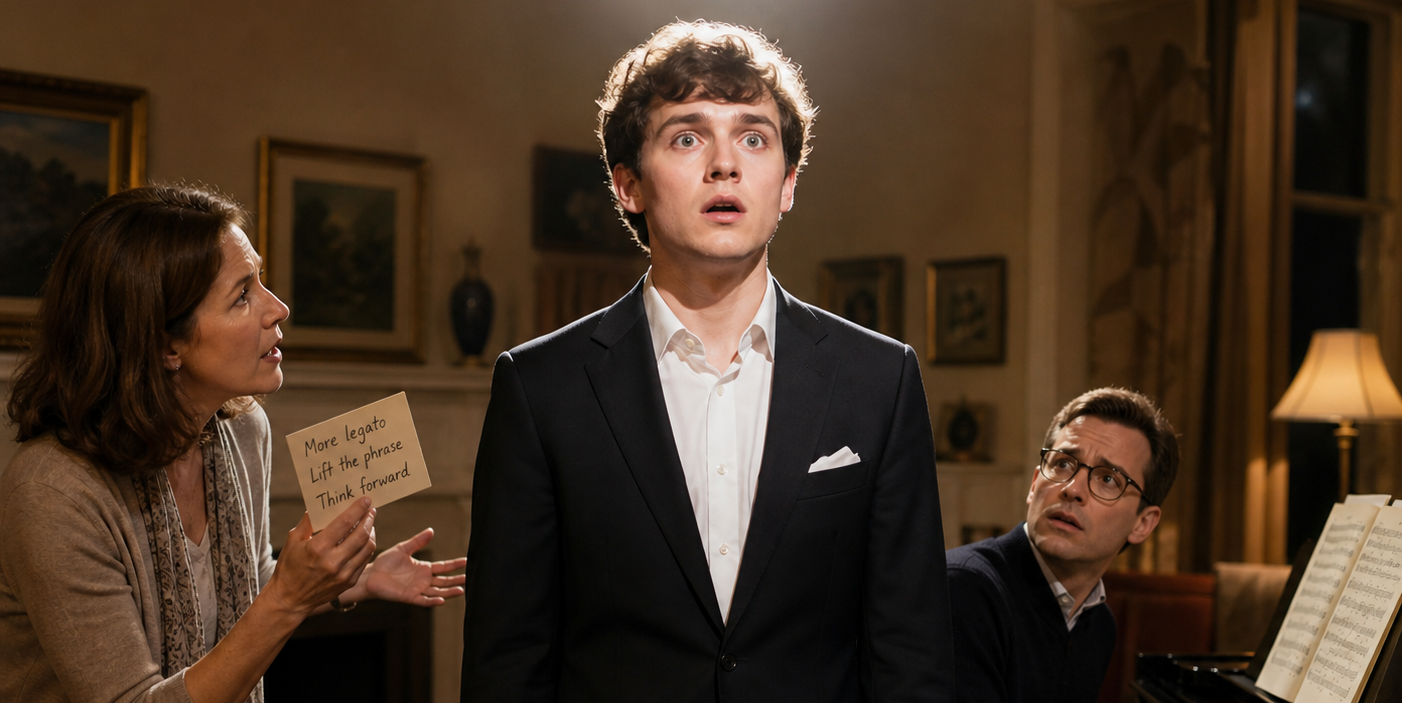
I know, it sounds obvious. Of course you’re going to act. Until you don’t. So many singers are hyper-fixed on making the best, most perfect sound that they get that “deer in the headlights” look and end up parking and barking the entire time.

You are not a vocal instrument mounted on a tripod. You are a performer. You are a storyteller. And yet, so many prescreen videos feature singers standing stock-still, eyes glazed, dutifully producing notes into the void. “Parking and barking,” as we call it. Just… standing there and singing.Now imagine you’re on the other side of the screen. You’re a faculty member. You’ve watched 87 prescreen videos today. They’re starting to blur together. And then someone presses play and this singer — this one — is actually alive. Their eyes mean something. Their face is telling a story. They’re communicating text, not just pronouncing it. They’re in it.
That’s the video that gets a second listen. That’s the singer who moves forward.
Remember the ten-second rule. You have a blink to stand out. Acting is how you stand out.
Practice Performing Before You Record
Here’s a scenario that plays out constantly: a singer has been working on their pieces for weeks. They know the music cold. They step in front of the camera, hit record, and suddenly everything changes. Their body tightens. Their face goes blank. They start listening to themselves instead of communicating. They finish the take, watch it back, hate it, and start spiraling.
This is camera panic, and the antidote is simple: perform in front of live human beings before you ever hit record. Sing for your family. Sing for your friends. Sing for your teacher’s dog. Sing for anyone who will sit in a chair and watch you. Get used to the vulnerability of being watched before the red light turns on.
The more you’ve performed a piece in front of real people, the more your body and brain understand that performing mode is the default — not the careful, self-conscious, “I’m being recorded” mode that kills artistry on camera.
Trust Your First Take
I’m going to say something that might feel counterintuitive, but I need you to hear it:
Your first take is almost always your best take.
Assuming you’re warmed up, feeling vocally healthy, and you’ve done the preparation — that first take carries an energy, a freshness, and a spontaneity that is nearly impossible to replicate. Sometimes the second take is different — maybe not better, maybe not worse, just different — and you might prefer it. Fine. Choose whichever feels strongest overall.
But do not fall into the trap of doing 15 or 20 takes. It doesn’t get better. It gets tired. Your voice gets fatigued. Your expression gets mechanical. Your patience evaporates. And then you’re sitting on your bed at midnight, scrolling through a dozen nearly identical videos, unable to tell which one is best because you’ve listened to yourself so many times you’ve lost all perspective.
Record. Maybe do one more for safety. Choose. Move on.
Final Details That Matter More Than You Think
Before you submit anything, handle the small stuff: Label your videos clearly. Title of the piece. Composer. If you’re not submitting through an audition portal, include your name. Make it easy for the people reviewing your materials to know exactly what they’re watching.
Triple check your edited video. Watch it from beginning to end. Then watch it again. Make sure you didn’t accidentally leave in the part where you say “okay, ready” to your accompanist, or the moment after you finish where you mutter “I think that was good?” or look at the camera person for reassurance. The video should start clean and end clean. Nothing but the performance.

These seem like tiny things. They’re not. They’re the difference between looking polished and professional and looking like you rushed through the process.
The Bottom Line
A prescreen audition isn’t about perfection. It’s about clarity — a clear voice, a clear artistic identity, a clear command of the material, and a clear sense that you are someone worth investing in, someone with potential.
Good lighting. Honest sound. Smart repertoire. Precise preparation. Real, human, alive performing. And the discipline to trust your work, trust your take, and hit submit.
You’ve got ten seconds to make them lean in.
Make those ten seconds count…
Now go record your first take. It’s probably the one.