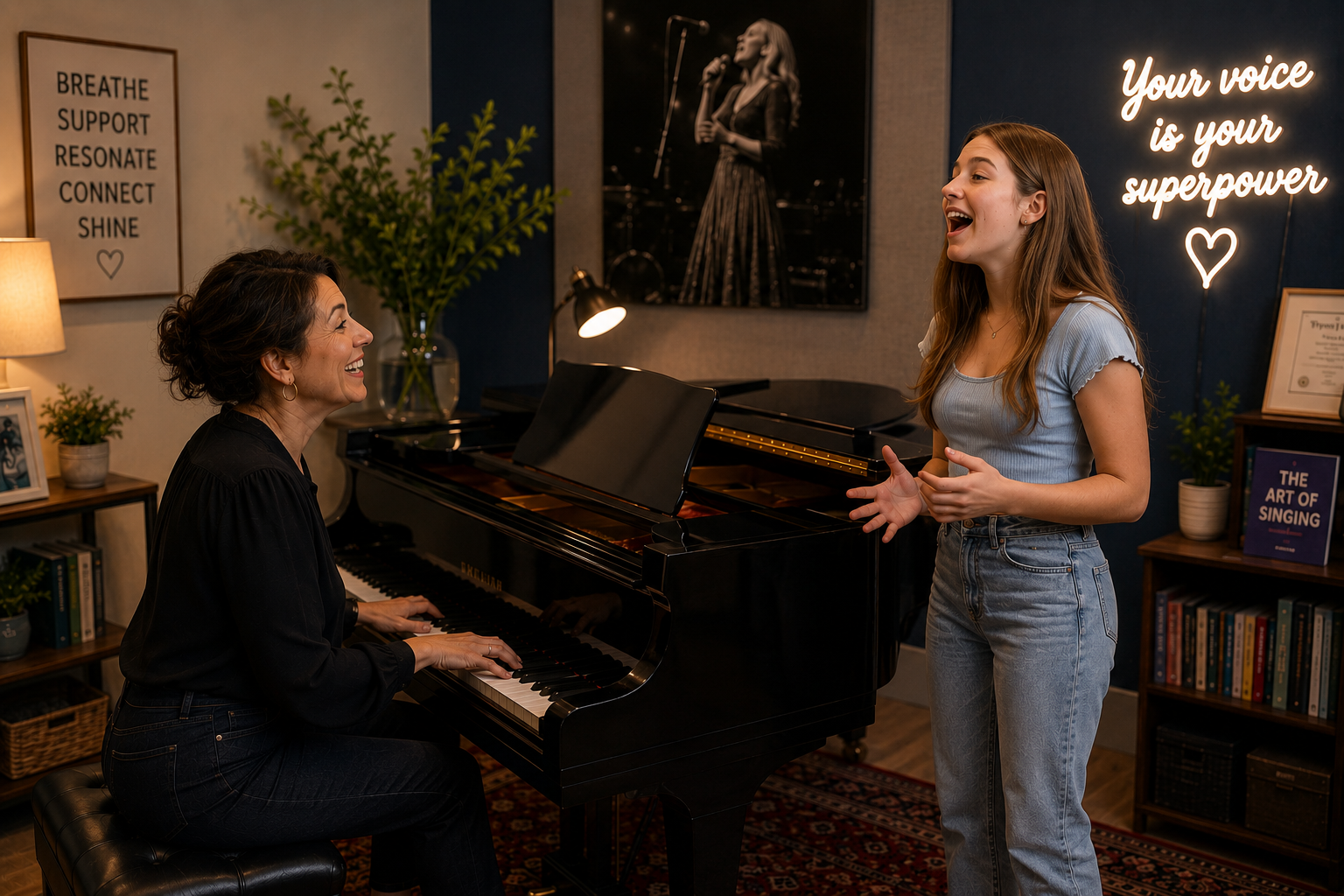
We’ll talk about this more in a later post, but the single most important thing you can do for your vocal career is find the right teacher at each stage of your development.
Finding the right voice teacher is less like shopping for a product and more like finding the right therapist — or, to use a more dramatic analogy, receiving an organ transplant.
Even in the absolute best-case scenario, it takes time for two people to learn each other’s language, to build trust, and to ensure that all the necessary elements are there for the relationship to truly take. The fit has to be right. The communication has to work. And the approach has to align with learn and who you are and want to be as a singer.
So before you hand over your voice — one of the most uniquely personal instruments in existence — to just anyone with a piano and a TikTok account, let’s talk about how to find someone truly worthy of that privilege.
The Performer vs. The Teacher Myth
Let’s address something that trips up a lot of aspiring singers right out of the gate. You may have heard the expression “Those who can’t do, teach.” False. However, the select few that can do both well are a small and exclusive group.
If someone has a jaw-dropping voice, surely they must understand voices, right? Not necessarily. Many elite performers operate largely on instinct, natural ability, and years of unconscious refinement, specific to their own instrument. When you ask this type of teacher how they do what they do, they may not have the faintest idea. “I just… feel it,” is not a teaching methodology.
The reverse is also true, and this one surprises people even more. Some of the most gifted, insightful, and transformative voice teachers in the world have modest performing careers — or none at all. What they do have, is an extraordinary ability to observe, communicate, problem-solve, and meet each student exactly where they are.
A good teacher and a good performer share some qualities, but they are fundamentally different skills. Keep that in mind as you begin your search. Ideally you’ll find someone who does both well.
The Top 5 Things to Look For
1. A Teacher Who Lets You Sing

This may seem obvious, but it’s remarkable how many instructors dominate the voice lesson with their own talking rather than the student’s. If you are spending the majority of your lesson time listening to lengthy monologues about the mechanics of the larynx, a description of the latest vacation, or a delicious sandwich, while your own vocal cords sit idle, something is wrong.
Singing is a physical skill. Like learning to ride a bike, you cannot improve exclusively through explanation — you improve through doing. A great teacher understands this and structures lessons so that the student is singing, experimenting, and experiencing. Information is valuable, but it should serve the singing, not replace it.
2. A Teacher Who Demonstrates Only When Necessary
There’s a fine line between a helpful demonstration and a teacher who can’t resist showing off. Occasional demonstrations can be genuinely useful — hearing a concept brought to life is worth a thousand words. But a teacher who constantly demonstrates, especially in a way that invites comparison between their mature, trained voice and your developing one, is doing you a disservice.
The best teachers demonstrate strategically — briefly, purposefully, and always in service of your understanding. Then they hand the moment back to you.
3. A Teacher Whose Language You Understand
Voice pedagogy is a world filled with colorful and varied communication styles. Some teachers are deeply scientific and technical — they speak in terms of resonance frequencies, subglottic pressure, and thyroarytenoid muscle engagement. For analytically-minded students, this is pure gold.
But for others, that language lands like a foreign dialect. These students thrive with imagery and sensation-based teaching — “imagine you’re sending the sound over a rainbow,” or “feel like you’re breathing in the smell of something wonderful.” Neither approach is right or wrong. What matters is whether the teacher’s natural language clicks with your learning style.
Some students are a combination of both of these learning styles, and others.
Pay close attention to this during your first interaction. If you find yourself nodding blankly while internally panicking, that’s important data.
4. A Teacher Who Asks You a Lot of Questions
A great voice teacher is, in many ways, a great detective. They are constantly gathering information about you — your history, your goals, what something felt like, what you noticed, what confused you, what excited you.
Questions are the sign of a teacher who understands that there is no universal solution — that every voice, every body, and every mind is different. A teacher who asks good questions is a teacher who is genuinely listening and genuinely invested in your specific journey, not simply delivering a pre-packaged curriculum to whoever shows up that day.
5. A Teacher Who Is Physically Present and Engaged
You can tell a great deal about a teacher simply by watching their body. Are they making eye contact with you when you sing? Do they lean in, nod, react physically to what they’re hearing? Or are they glancing at their phone, drifting toward their computer, or staring into the middle distance?

Energy is contagious in the studio. A teacher who brings focus, enthusiasm, and genuine presence will elevate your own engagement and performance. A teacher who seems like they’d rather be somewhere else will quietly drain the life out of every session. Trust what you feel in that room — your instincts are rarely wrong.
Red Flags You Should Never Ignore
Now that you know what to look for, let’s talk about what to watch out for. These warning signs may be subtle in a sample lesson but can become deeply frustrating — and even damaging — over time.
The One-Size-Fits-All Teacher: If you observe a teacher giving essentially the same lesson to every student, regardless of age, voice type, or ability level, walk away. Good teaching is responsive. Every student presents a unique puzzle, and the teacher who cannot adjust their approach accordingly is not truly teaching — they’re broadcasting.
The Teacher Who Can’t Find Another Way to Say It: If a student doesn’t understand a concept, the answer is never to repeat the same explanation more loudly or more slowly. A skilled teacher has a deep toolkit and can come at any problem from multiple angles. If you find that a teacher keeps circling back to the same words and phrases no matter how lost you look, that toolkit is probably shallow.
The Teacher Who Stops You Constantly — But Says Nothing Useful: There is a particular brand of frustration reserved for being interrupted mid-phrase, only to be met with vague dissatisfaction. “No, no — do it again” is not feedback. Corrections should must be specific, actionable, and clear.
The Teacher Who Corrects Before You’ve Even Sung a Full Phrase: There is an implicit roughness in stopping a new student repeatedly before they’ve even had a chance to find their footing. Good teachers know that the early moments of a lesson — and especially an introductory lesson — should be about observation and trust-building, not immediate correction. A teacher who pounces the moment your tone isn’t perfect has forgotten what it feels like to learn and how an organic process like singing, functions.
The Sample Lesson: Your Most Valuable Tool
When you’re in the initial stages of exploring a teacher, a sample or trial lesson is absolutely non-negotiable. Some teachers offer these free of charge; others will ask for their standard rate. Either is reasonable. What you’re purchasing is information, and that information is invaluable.
Here’s what you must remember, though: a sample lesson represents a teacher at their very best. They are motivated, prepared, and performing. They know they are being evaluated. If you have significant concerns about what you witness in that first lesson — if red flags are flying, if the language isn’t landing, if you leave feeling flat or confused — do not rationalize it away. Do not tell yourself it will improve once they “get to know you.” If this is their A game, it is the ceiling, not the floor.
Trust what you see. Trust what you feel.
The Foundation of It All: Honest Dialogue
Whatever teacher you ultimately choose, there is one tool more powerful than any technique or method: open, honest communication.
Tell your teacher what’s working and what isn’t. Tell them when you’re confused, when something feels wrong, or when you’re struggling to connect with their language. Invite them to do the same with you. The best teacher-student relationships are built on mutual curiosity and candid conversation — not on performance, not on deference, and certainly not on silence.
Finding the right voice teacher takes time, patience, and a fair amount of self-awareness. But when you find that person — the one whose words unlock something in your body, whose energy fills the room, who sees your voice the way you hope to one day see it yourself — the search will have been entirely worth it.
Where do I even start looking for a teacher?
This may sound obvious, but start looking for a teacher through the singers who you love to hear in your school or region. A good singer most likely has a good teacher. Start with those recommendations. If you don’t know anyone in your circle who feel is a good vocal role model, start at one of the following places:
Universities
There are excellent institutions of higher learning all over the world. Look up the vocal department, read the bios of the voice professors and listen to any links they have posted of their singing.
Those universities will have recitals and concerts throughout the year. Go hear them and see what the singers are like. Find out who teaches them, and if it’s the teacher giving the recital and you like what you hear, reach out, they’ll know what to do next!
Classical Singer
This resource is for all singers, not just classical singers. I cannot say enough about how helpful this organization is for the development of singers at all stages. One of the excellent things they offer is a teacher directory on their website. Click here to take a look.
They also hold an international vocal competition in May every year. Schools from all across the country and the world come to judge singers, teach masterclasses and participate in the college expo.
You won’t find a larger gathering of singers all in one place. It’s the best way to observe teachers from multiple institutions so you don’t have to make 4 or 5 visits to them first before you even know if the school or teacher you are looking at might be a good fit.
In addition, Classical Singer also has a database of programs and schools for singers of all ages and levels of experience. I highly recommend you sign up for a free account and start using this excellent resource.
NATS:
The National Association of Teachers of Singing (NATS for short), has a great database with info about teachers near you. You can browse by region and find out what styles and ages of students they teach. You can even use this database to find pianists, which singers ALWAYS need! Click here for a link to the database
Your voice is waiting. Go find that perfect match!